Wednesday, August 31, 2011

31 August 2011 - Mossman Riverside Leisure Park, Queensland


The morning dawned overcast but still warm, the mountains all around still shrouded in low clouds. I do wonder how often they reveal their splendour to the visitor.

By nine thirty we were on the road, first popping up town to buy the regular newspaper and then heading north toward the Daintree River where we joined the queue for the ferry. We were very pleased to find the return fare was only $22; pleased because we had guessed it might be double that. The ferry here is larger than that on the Jardine River much further north and the river wider, but the ritual is still the same, however the staff are more official looking, sporting the bright yellow fluro shirts that all employed folk here in Australia seem to wear.

Once ashore we continued up the sealed narrow and winding road as it climbed up over a range, where we stopped to over look the mouth of the Daintree River but were not able to make out Port Douglas further south, nor Cape Tribulation to the north through the haze.

As we descended the range, we took a detour to enjoy a boardwalk up through the rainforest. Everywhere signs alerted us that cassowaries lurked in the area, not to be fed or approached, however we did not see any. We did however appreciate the beauty of the forest, the best of its kind we have seen.

Once down to the coast, we drove the six kilometres to Cow Bay, where the rain forest grows right down to the shoreline and one is greatly discouraged from swimming or any other activity that would excite a crocodile. It was only 11 am but we were hungry and a cup of coffee sounded great, so we consumed our picnic then and there.

No one seems too sure why this bay is thus named; it may relate to the sea cows or dugongs that feed on the seagrass in the bay, the cattle who used to graze near the beach or the cattle being swum from barges transported for fattening in the 1940s. We noted a sign advertising an activity for tourists: Cow Bay Horse Riding, and thought that a rather wonderful play on words.

Returning to the road north, closely hugging the shoreline, we stopped once more to take advantage of another boardwalk on offer, this second one along the Oliver Creek through mangrove flats. Having lived close to mangrove tidal flats for so many years in New Zealand, we thought we knew all about them. At the museum in Townsville we had learned there are over 90 different species of mangroves, and again yesterday on the Daintree River, we received further revelations. Today as we walked through this amazing area, we could see that these mangroves had very little in common with their Whangarei harbour relations.

The reference beside me here advises that the sealed road from the river to Cape Tribulation is 34 kilometres; I would have thought it more because the distance from Mossman to Cape Tribulation is just short of 70 kilometres. Whatever the correct distance, the road is slow and sports more cassowary signs than there are cassowaries, and more tourists than we have seen for a while. We passed so much on offer for the tourists; B&Bs, cafes, campsites, insect museums, zoos, tea plantations, nature tours, crocodiles adventure tours, and so on. Just like Cape York, the area north of the Daintree River does not have electricity except for that generated by the user.

In 1931 the Mason family were part of a small group who settled the area and subsequently attempted to earn a living from fruit and vegetables, timber cutting and cattle, and today are involved in the tourist industry, conducting tours, operating a café, a shop and bottle shop.

The heights of Mt Sorrow shrouded in cloud
In 1962 the first gravel road reached the area, now it is sealed all the way to Cape Tribulation. There are now approximately 600 to 900 permanent residents living on the Daintree Coast, and more than 1,000 freehold subdivided blocks dotted along the edge of the National Park.

When we reached Cape Tribulation, we found a park between the many cars and vans, tour buses and 4WDs, then walked first to the beach which was marginally more expansive than Cow Bay, and then around to the look out on the Cape itself. Rain had already set in and we walked with our umbrellas. It seemed appropriate that we should encounter rain in the rain forest lands, but unfortunate, even sad, that we were not able to see Mt Sorrow, named by Captain Cook. It was just off here in 1770  that he came aground on the Great Barrier Reef, that section now named Endeavour Reef, and the cape Tribulation to mark his woes.

We stopped at the “largest supermarket” on the Daintree Coast (the only one) to buy iceblocks and saw odds and ends for sale at inflated and odd prices; avocados were marked at $2.44 each, cornetto icecreams at $8.88. When I drew the storekeeper’s attention to this peculiarity, he laughed and said he liked to amuse the tourists and keep the locals on their toes.

We swapped drivers part way back and I drove the tricky bit over the last range. I don’t get enough practice driving this manual vehicle so it was just as well Chris was sleeping and did not notice my dodgy gear changing. When we arrived back at the ferry, and joined the even longer queues, we missed the first and when it returned there was a car with a flat battery obstructing the ramp. The driver asked us to help him start it with jumper leads, so we drove onto the lift up ramp in an effort to assist, but his problem was too great for the quick fix. We ended up towing him off so we could all board the ferry and continue on our way.

There is a new batch of caravanners in tonight so it must be time for us to be on our way. No doubt there is much more that could be seen in Mossman and the environs, however Cairns and business matters beckon.

Tuesday, August 30, 2011

30 August 2011 - Mossman Riverside Leisure Park, Queensland


We had little planned for today, in fact the only activity was not scheduled until late afternoon, so the day passed in the way retired folk often pass their days; reading, walking and on line.

After morning coffee we walked the length of Mossman’s main street, popping in to the newsagent for the newspaper and to print off our e-ticket, and Woolworths to buy bread and cheese, the latter having been absent from our diet since the last block died a melting death with the lack of refrigeration after we embarked on our Cape York expedition. How I savoured a greedy helping of this wonderful treat at lunchtime, and we will continue to do so because the cheapest way to buy it was to buy a whole kilo and we have only four more days to consume it all. Heaven forbid we have to discard any of it!

See the monitor?
The strong smell of molasses hung in the air, drifting across from the sugar mill. I had noticed this when we arrived back at Mossman yesterday afternoon to book into the camp, but had not noticed it again until we ventured down the street this morning. I guess the residents are used to the smell as those in Rotorua are to the smell of volcanic sulphur. Having said that, the sweet pollution from the mill is not entirely unpleasant.

No sooner had we returned from our walk, did a huge monitor make its way across the park close to the caravan, disturbed at one point and resting up a tree, his head a metre and a half up and his tail still partly draped along the ground. Eventually he moved off down to the river. I had nearly run in to him except for the warning called by a fellow camper. I doubt these creatures would be dangerous (unless you cornered them) but they do not endear themselves by their presence.

We set off back toward the Daintree Village at 3 pm calling in to a rural fruit and vegetable store where we purchased a pineapple which disappointingly turned out to be less than acceptable once cut into.

Cruising on the Daintree River
Crocs lounging on the river banks
A couple of kilometres past the ferry turnoff, we found Bruce Belcher’s Daintree River Cruises, and at 4 pm, low tide on the river, we boarded the Mangrove Jack II with four others for an hour long cruise that turned out to be nearly an hour and a half long. We crawled downstream hugging the shore of the Daintree River, spotting Azure Kingfisher, Great Billed Herons, Great Egrets, Cattle Egrets, Little Egrets, Little Kingfisher, Sacred Kingfisher and of course crocodiles of all ages and sizes which the cruise was really all about. The captain of the boat, Ken who like us had been a grey nomad until he got waylaid by Bruce Belcher, was most informative regarding the flora and fauna of the river side area. We both enjoyed the cruise very much and would thoroughly recommend this operator as giving value for money, and a host of interesting information.


Monday, August 29, 2011

29 August 2011 - Mossman Riverside Leisure Park, Queensland


Today I received an email from my daughter-in-law Kyla who said” I cannot imagine what it must be like to be so free spirited and to go where the wind blows you!” And of course how could she, or how could we have ourselves when we were at that same stage of life, when one has a family to bring up and the structure of employment. But now we certainly do delight in the random plans of our lives, some which need greater thought than others.

Our plan was to travel to Mossman, and on up toward Cape Tribulation, as far as the less intrepid travellers could reasonably expect to go. As we had pulled in to that excellent little rest area at Mount Molloy, we had been intercepted by a couple who had been at the Cooktown Orchid Traveller’s Park with us, who had just heard about a camp at Daintree Village, mentioned in the updated Camps 6 bible, charging a very fair $15 per night. We had intended to check out the camp at Wonga Beach mentioned in the earlier edition of this travel bible, but were interested to learn of this alternative. We did however stay with Plan A then, to pass the one night at the Rifle Creek Rest Area, while the other party set off to Daintree Village having rung ahead.

This morning we came on through to Mossman, descending from the Molloy Tableland through lush tropical forest and farmlets, down a very steep winding road to the coast. From the two view points on the road, one could see the patchwork of the sugar cane fields laid out far below, however the rain mist lay all about so I did not even bother with photos.

Mossman, as opposed to Mosman, the smart suburb in Sydney, is a small rural town servicing the farms about which grow sugar cane, pawpaw, bananas and no doubt  other crops. We shopped for fresh produce at the local Woolworths and today’s newspaper at the local newsagent, enjoying the ambiance of the place. There is nothing pretentious about Mossman, it is more our kind of town.

We unhitched the caravan on the street opposite the police station and drove up the Mossman Gorge, situated in this lower section of the Daintree National Park. As we travelled up the narrow very pretty road, we could see why caravans were not allowed. We were surprised to find so many cars in the car park at the end of the road, just after nine o’clock, and even more surprised to see the crowds of camera carrying tourists on the elevated walkway enjoying the lovely scenery; the Mossman River rushing down through the granite gorge through lush rainforest. After donning our sturdy shoes to do the more challenging of the easy walks, we were disappointed to find the way barricaded for safety, and so we walked the same track as those other tourists; the elderly, the disabled, the slow and the foreign.

Within an hour we were back down in Mossman, hitched back up to the caravan and heading north for a spot to park up, read the paper and eat the artisan bread we had purchased. Some celebrate their anniversaries with champagne and some with yummy bread; today is another of the anniversaries Chris and I celebrate, the day we started to share the same roof on a permanent basis, however neither of us could remember whether it was fourteen or fifteen years. Whatever, the bread was excellent and we both ate too much. We had found a park at the southern end of Wonga Beach, so walked out on to the beach to find the tide in and the sand just a narrow strip between the quiet sea and the overhanging trees.

We drove on north and then inland to Daintree Village, the road following the Daintree River. Arriving at the village we found it to be charming, the public areas tidy as a pin and the village busy with café diners and souvenir shoppers. We had phoned through to the Daintree Riverview caravan park last night to book for three nights, clearly stating that there were two of us, that we wanted a powered site and confirming the tariff of $15. Today we pulled in and found the office and Sally, who Chris had spoken to on the telephone. Yes, she found the booking and that will be $90 thank you. “No!” a shocked Chris said. “Yes”, she said, “$30 a night”. Certainly a misunderstanding but one that should have been corrected by Sally on the telephone. We told her that she could stick her $90 but in a much more polite fashion and drove back down the river, heading back to Wonga Beach. We had also telephoned the camp there last night to check on their tariff; $25 and obviously rejected that as being more expensive than the Riverview camp. Now we drove in ready to pay the higher tariff and were dismayed to see the "No Vacancy” sign up. I went in and asked if “No Vacancy” did actually mean NO vacancy. One always lives in hope that when they see my honest face, they will just fall over themselves to make room at the inn, but alas, not so. We then rang the camp at Mossman which we had passed earlier in the day, checked their tariff and drove the fifteen kilometres back to check in.

The camp here is situated right on the Mossman River and right beside the municipal swimming pool. We do believe that it is the council caravan park, although it does not advertise itself as such. We have received a seniors discount so are paying marginally less than the Riverview park wanted, however as Chris says, it is all about principal.

The rest of the day has been spent doing laundry and organizing our flight back to New Zealand when we return to Cairns. This is not a simple matter of buying tickets; we have storage of our rig here in Australia and the pick up of our motorhome in New Zealand to arrange, and so much more. However this blog is about our adventures here in Australia and will remain so.

The evening is still very warm; the windows are still wide open but well screened from the bitey mites who have been giving Chris hell. We do not look forward to the colder climes across the Tasman Sea!

28 August 2011 - Rifle Creek Rest Area, Mount Molloy, Queensland


The whole point of extending our stay here in Cooktown was all about the rugby, so it is with great regret I have to report that the All Blacks lost the Tri-Nations 2011 series to the Wallabies. The game was scrappy, the ball was slippery and the Wallabies played as if they were on P. The day’s events had taken their toll on my stamina and without a string of All Black tries to keep me awake, I retired five minutes before full time, to hear the end as I drifted off: “Wallabies have won! 25 to 20”.

We left Cooktown this morning soon after the church bells were heard ringing, under clear skies and with the temperature already well in the twenties.

A road retraced from the opposite direction is always like an entirely different journey, and so it was today as we traveled the 240 or so kilometres back to Mount Molloy.

The rocky Annan River
We paused at the Annan River crossing not too far south west of Cooktown to walk along the river over the huge rocks that form a canyon. The small river falls through these channels noisily and is quite spectacular. There we met up with a cyclist we had passed further back, a sun dried man of indeterminate age, bare to the waist down curled up on a rather tatty sleeping bag resting beside his bicycle. Despite his scruffy appearance, under long hair and a scraggy beard, he was an interesting, relatively intelligent individual who told us he had cycled up to Cooktown from down Atherton way, and was now on his way back. He slept by the road side when night fell and had during his trip been attended by several snakes, one last night, a black python of about eleven foot, none of whom had been a problem! Quite a character for sure and we reluctantly excused ourselves or we may have been there all day. Both Chris and I agreed that there was something wrong with the welfare system, even here in Australia, when a man capable of cycling in these parts over such distances should qualify for a disability pension.

It was still early when we reached Lakeland, the stepping off place for our canvas camping adventure, and so we continued south along the road toward Cairns, enjoying the countryside even more than on the way north.

I was astounded to see the remnants of thrown tyres on the roadside, hundreds of them. Chris suggested that it was probably because those who had deflated their tyres to absurdly low pressures for the 4WD conditions, far below the tyre manufacturer’s specifications, had not bothered to re-inflate them when they returned to the seal. In this heat and with the greater speed, the rubber swells and of course simply explodes. I guess the black shredded rubber is better than road killed feral pigs and roos.

At the lookout on the Byerstown Range, from where we could admire the relatively fertile and extensive Lakeland Downs basin, we chatted with a couple who were on their way north, towing a caravan. They had been told that the road to Weipa was sealed and were interested to know how realistic it was to consider taking the caravan right up to Bamaga at the top. We soon put him right as regards the state of the roads and told them that it would be insane to pull the caravan any further than Laura. They were at least as old as us, without a tent, and with only one sleeping bag. We suspected they would ignore our advice anyway and proceed on up regretting their decision within fifty kilometres of leaving the seal.

Our camp beside the road near Mount Molloy
We arrived here at the crossroads of the Mulligan Highway and the road across to Mossman soon after two thirty, and seeing that there were already twenty or so parties in here, quickly selected our own spot and backed in. The amenities at the rest area include toilets, cold showers, rubbish bins and an “iron-maiden” (NZMCA speak for secure collection post) to accept our $2 donation for the use of the facilities. What more could one wish for?

Saturday, August 27, 2011

27 August 2011 - Cooktown Orchid Travellers’ Park


Last night we enjoyed the free entertainment staged at the hotel up on the corner, from the comfort of our own caravan. Fortunately the music was “dated” and thus to our taste in popular music. It was however at several decibels higher than the night before and may not have been as welcome to others. They played much later last night however I still managed to fall asleep, no doubt enjoying the lullaby effect from this distance.

I checked the thermometer once I was up and about at 7 am to find it was already 24 degrees and the wind was yet to come up. We were breakfasted and ready for our day’s adventure before our pre-arranged Skype call with the big grandkids. It was good to see them and a bit scary to see how they have grown since we last saw them. We will be that much more surprised when we see them in the flesh, I am sure!

Soon after 8.30 am we were down on the waterfront wandering about the Saturday morning market. Our purchases there were paltry; a tropical passion fruit from a woman who had come up to the area less than nine years ago from Sydney, now cultivating all sorts of weird and wonderful tropical fruit. She pointed in the general direction of her property, north west toward and beyond the airport, the hazy view she blamed on all the recent bushfires. We assured her we had seen the wonderful views on a clearer day and we could see why she lived in such a lovely place, but I did privately wonder how she could adapt from the throb of Sydney to the sleepy isolation of Cooktown.

The only other purchase at the market was a pawpaw which we shall enjoy tonight with the passion fruit. It should be noted that this one passion fruit is very large and I have great expectations of the amount of pulp that will be extracted.

We then popped in to the IGA supermarket and overcame our prejudice in paying exorbitant prices for fruit, buying apples, tomatoes, more carrots and some meat bargains marked down to the ridiculous fire sale price of just $2 a piece.
Endeavour Falls
We returned briefly to the camp and to place our purchases in the fridge, then we set out on our excursion north west, with no definite destination decided. We followed the Endeavor River up the wide valley, admiring the small holdings along the way, and then stopped at the Endeavour Falls Caravan Park to ask if we could see the falls. We were generously directed to proceed and told where the donation box was at the gate. The falls are very pretty but the best view would be from the bottom and given that there are crocodile warning signs everywhere, we did not venture thus, limiting our viewing to the top side of the falls where we figured large crocs could not reach. Chris is exhibiting great respect for these monsters and in doing so, will probably save me from what may otherwise be reckless adventure.

We proceeded on across the road that leads through to the Lakefield National Park, emerging at either Laura or Musgrave, both points on the Peninsula Development Road. The Battle Camp Road shows on maps as being only suitable for 4WD and we were both sure we had seen it featured on the Gall brothers’ DVD (of Kedron Off-road Caravan fame) as being a rather reckless alternative route, or at least reckless for the likes of us. And yet, since being here in Cooktown, I have been surprised as to how many people had taken that option and in doing so added to their 4WD experience.

Isabella Falls
We were keen to continue on until we reached the Isabella Falls on the creek of the same name. The road was excellent until then and we forded the creek with no problem, walked to the base of the falls, took the obligatory photographs and chatted with a couple of guys who were just setting out on their Cape York expedition.

Given the state of the road, we were keen to carry on, at least for a while, and so we did, continuing on over the Battle Camp Range on a beautiful road, 99% of which was as good as the best of the PDR. The two possibly problematic river crossings reported in Ron Moon’s 4WD bible, the first being the crossing over the Normanby River, turned out to be easy because, while a little deep, there were narrow concrete slabs across to remove the danger of falling in to any mysterious holes.  Finally after 84 kilometres, we entered the Lakefield National Park where the road did start to deteriorate. 

Lake Emma
We turned off and drove less than a kilometre north to Lake Emma, and then again to Horseshoe Lagoon two kilometres off the road. Both of these were lovely, but the land lay low all about and the signs back at the road had advised that not only were there crocodiles all about, but they were protected for conservation here. We were not keen to hop out of the vehicle to explore, and it had occurred to me as we turned off the main road on to the narrow track with our UHF radio still broken, we would look rather foolish if we found ourselves stranded for whatever reason. Who knew when some other vehicle might take a similar detour?

Succulent flowers; a treat for a roo
Needless to say, nothing untoward happened and we emerged safe and sound back out on the road and carried on toward the Laura River, crossed just a few days ago further upstream just at the northern edge of Laura. The crossing was uncomplicated and we were soon across and up the other side where we stopped to have our lunch. It was dead on midday and we are sticklers for routine! While we later discovered a spot on the other side of the road, which offered more shade and privacy, we had a lovely picnic in the company of an old male kangaroo who carried on grazing on the succulent red flowers that were falling from the large trees above us like intermittent snow, the butterflies, flora and the great variety of birdlife.

Old Laura
After lunch we drove the last half kilometre to Old Laura, the old homestead that is now part of the National Park, which stands at the cross roads where one would take the decision to go on up through the rest of the National Park to Musgrave or cut the 28 kilometres through to Laura. This fifty square miles of land was taken up for farming in 1879 by a couple of Irishmen and was occupied until 1966. The Queensland National Parks and Wildlife Service purchased the property in 1978, by which time the buildings had been vandalised and deteriorated with time. Restoration was carried out, but only so far as to make it look as if it was abandoned and neglected, but still recognisable as a station homestead. Net wire protects the homestead itself from uninvited entry, but there is a collection of stories and photos on boards under the verandah which we found interesting.

We chose then to turn back and retrace our route to Cooktown and enjoyed the journey as much as the opposite journey out.

Jacana walking on the waters of the Barrett Lagoon
I was keen for us to call in to the Barrett Lagoon on the return to the Endeavour estuary however as we have found only too often, the tourist information expounds the virtues of an attraction, but does not show clearly where it is on their local maps. We zigzagged across the valley, generally heading in the right direction but never quite finding it. Giving up, we went instead to the Keating Lagoon on the road toward Cairns, easily found and well signposted with maps and information about the array of birdlife. We were particularly fascinated with the jacanas, who not only feed but also nest on to top of the floating lily leaves. They moved with such feathery grace across the top of the lagoon, impressing us with their behaviour and with their distinctive deep pink wattles.

We did have a moment, or rather a nano-second of excitement when Chris thought he saw a crocodile sliding across the muddy shallows, however on further scrutiny, nothing could be seen and we will still have to resort to a commercial experience to get up and personal with these terrifying creatures.

From there it was a short run back to camp. The day has clouded over and the wind has died away again, if it ever came up here in Cooktown today. Chris just came in and said he had felt a few drops of rain; I doubt it will come to much, however I shall not mind if it does. We are no longer confined to a tent, and tomorrow will be spent getting from A to B before exploring another part of this lovely country.


Friday, August 26, 2011

26 August 2011 - Cooktown Orchid Travellers’ Park, Queensland


It is now late afternoon and still very warm however the wind has abated or perhaps just swung around to a different direction; awnings and trees are not being buffetted to the same degree as this time yesterday. We have returned from our day’s outing empty handed as far as anything interesting for dinner and Chris is anxiously considering the dinner I have planned; tuna and potato cakes created from the remaining cans of our expedition. We have in fact returned from the Far North with dozens of canned vegetables, fruit and soup, and will be making our way through them for some time to come. The cans of meat style meals have however been consumed and we will have to resort to re-provisioning from the local IGA when it reopens tomorrow.

As so many times in the past we have arrived at a place in time to share their annual show day holiday. It seems that here in Australia, there are the statutory holidays you would expect; Christmas, Boxing Day, and the days that follow, then Easter, New Years Day, Queen’s Birthday, then there is Australia Day and then a Show Day that seems to be isolated to the shire or town rather than state.

This morning immediately after breakfast we headed up to the “Events Centre” to check the annual Cooktown & District Country Show out, to find we were about half an hour early. The sausage sizzle was underway so Chris was able to do his bit in supporting the local lifesaving club. (That actually is rather strange because I do wonder where the club do their saving. All the beaches around here are crocodile infested and thus swimming is not encouraged) The snack was a more reasonable $2 rather than the inflated price encountered on Thursday Island, and was of at least equal quality. We decided to return later in the day when everything was swinging and check out the locals in their leisure mode. Somehow that never happened because we found ourselves engaged in other pursuits.

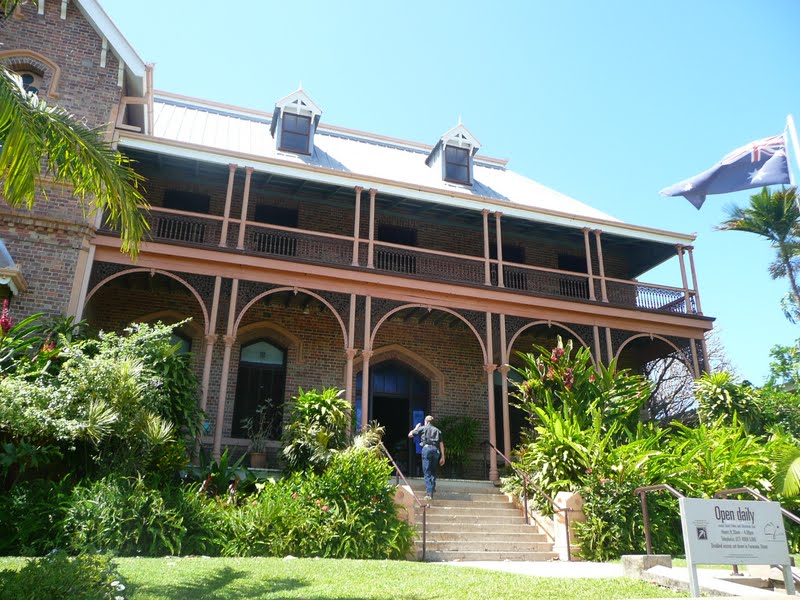
The wonderful James Cook Museum
The James Cook Museum was on our must-do list, with its reputation having preceded our arrival here. Obviously the main theme is all about Captain James Cook, but it proved to be so much more. The museum is housed in the restored Sisters of Mercy convent school building, a grand two story building built in 1889, and restored more recently after it fell into disrepair.

We spent the morning sitting in front of a television watching a very long DVD, and actually tore ourselves away before it had finished, returning to the camp for lunch, then back to the museum to watch the end of the film. The film is a brilliant Australian production about James Cook, the man, and what he was like rather than just the places and events that occurred under his command. We were keen to lay our hands on a copy but unfortunately the curator’s requests to the ABC have been ignored or dismissed as trivial, and the well stocked museum store is still without this excellent potential gold mine. We will however look out for our own copy the next time we are in a large shopping mall that sports an ABC shop. (ABC being the Australian Broadcasting Corporation)

We spent a good part of the afternoon delighting in the rest of the exhibits, apart from the exhibits around the Endeavour’s adventures around Cooktown. Obviously there was much about the Palmer Goldfields, the large Chinese population and society that grew up around that mass immigration (albeit much of it fairly temporary), the convent’s history itself, aboriginal culture and stories of the impact of white settlement on that, and stories of local identities who have helped make Cooktown the place it is. I was interested to learn that road access to Cooktown only came in 1937 and the Mulligan Highway was only sealed in 2006. This emphasizes the isolation of the place and helps justify the fact that today’s Cairn’s Post marked with a retail price of $1.10 sells for $1.45.      

From the museum we drove across to Finch Bay on the Coral Sea coast, a lovely sandy bay lined with mangroves and coconut palms, where I walked barefoot along the beach.

Just half a kilometre back along the road toward town, we stopped and walked around the Botanic Gardens, one of the oldest in the country. These were originally established way back during the gold rush years but neglected once the gold ran out. Subsequent bush fires and cyclones did further damage, however in the middle of the last century when Cooktown was having a facelift in preparation for selling itself as a tourist destination, many wonderful specimens were rediscovered, and with new plantings, nurtured to health once more. While not a great park, we did enjoy the shade and shelter from the relentless wind in the shelter of Grassy Hill.

After the variety of the day, we thought better of returning to the crowds at the show and returned for a quiet afternoon coffee and to read the newspaper.

25 August 2011 - Cooktown Orchid Travellers’ Park, Queensland


A flash name for a very ordinary but nice park in a delightful little settlement. We are well settled in here for a couple of days and have excellent internet hence I have been able to upload photos on to this blog and to my Facebook page.

We were also spoilt this morning with an excellent road across from Lakeland Downs, all sealed and in good order. Here in Australia a sealed road does not necessarily mean a good road. In fact our experience with most roads here in Australia is that, apart from the major motorways in places like Brisbane and Sydney, they are totally crap. However one of their redeeming features is that there are generally very good rest areas at regular intervals for tired drivers to pull over and take a break, something that is greatly lacking in New Zealand.

The Mulligan Highway connects Lakeland Downs with Cooktown, just 82 kilometres through some lovely country. There was frequent evidence of cattle stations, not just the odd beast grazing in the roadside bush but yards, homesteads and fences. There were still many signs warning of cattle grazing unfenced by the road and of roos crossing. We had left Lakeland promptly and did in fact encounter quite a few roos either waiting to cross or bounding daringly across ahead of us, before it became too hot for such exuberance.

We stopped at the Black Mountain, an imposing pile of black granite boulders, black because of the lichen growing all over them. There is an abundance of birdlife all about them but fewer wildlife of a different kind. There are great crevasses under and through this boulder mountain which have swallowed up careless beasts and men.

We soon arrived at Cooktown, tracked down the Information Centre to ascertain the cheapest camping ground and made our way here. This camp while still more expensive than that stayed in at Cairns, is centrally located and has a nice ambience; before lunch we walked up to the superette to purchase some fresh produce. Chris found a pork pie in the deli section and having been deprived of this delicacy all year, indulged. Fruit here is still at a ridiculous price so raw carrots were the order of the day, and probably just as healthy a close to lunch as any fruit would be.

At the newsagent we were pleased to be able to buy an Australian, just one day old and at only $1 more than the normal retail price. We are now aware of the progress that has been made in Libya with Gaddafi on the run and resolution looking more possible and within our life times.

Capt. James Cook, for whom Cooktown is named
Back in the late nineteenth century, Cooktown was the through port for those who came to plunder the Palmer River Goldfields, gold discovered by William Hann (immortilised in the naming of the Hann Roadhouse on the Cape York road north) in 1872, becoming a service town of 3,000 for the 15,000 to 20,000 miners, a greater proportion of Chinese over any other nationality. Apparently by the end of 1875, of the 15,000 miners on the Palmer, 10,000 were Chinese. There were once numerous hotels and stores here, but after the gold dried up, the settlement here died with it. Back in the 1950’s an entrepreneurial chap saw the potential of Cooktown as a tourist destination and the rest is history. It is however, because of its relative isolation, still a back water, albeit a charming one. The bulk of travellers who pass through are those who do the Cape as we did but come on through Cooktown and up through Lakefield National Park, making the whole experience just that much more than we did.

Cook's landing place, going nowhere
After lunch we drove along the river front stopping to view the various historical monuments. This is where Captain James Cook landed and settled for 48 days, making him the first white settler here in Australia, while his ship, having run aground on the Great Barrier Reef, was repaired. There is a statue of the Captain, a plaque marking the landing place and a musical ship made from polythene pipes. There is also opportunity to take a river cruise or two, croc spotting. We have however decided to do this when we arrive in the Daintree National Park, the brochures suggest they offer the same thrill for less, however the proof will be in the paying.
  
Views from Grassy Hill
Cooktown has several features in common with New Zealand’s Wellington; situated on the water, of great historical importance as far as white settlement, but most of all, the wind. While the temperatures have been very pleasant, the wind has been such that we have decided not to bother with the awning from here on. We drove up to the top of Grassy Hill, to the lighthouse which was built in England and shipped to Cooktown in 1885, and from where one can enjoy panoramic views of Cook Town, the Endeavour River and the Coral Sea. It was so very unpleasant there, we spent only enough time to acknowledge it did offer all those views, captured them to the best of our ability on camera and left forthwith.

We have decided to extend our stay here in Cooktown mainly because here we can receive television coverage of the next Tri-Nations Rugby game being played in Brisbane on Saturday.  I am sure the management will oblige.