Monday, August 27, 2012

24 August 2012 - Mulgildie Hotel, North Burnett, Queensland


I woke early this morning to the sounds of the country birds all about; the magpies and crows, the galahs and all the others that abound, although the kookaburras seen last night were silent, if there at all. I was also pleased to hear a whispered “Happy Birthday” wish from my waking husband; I did wonder if he would remember. The strange thing is that I feel no older today than yesterday, and while this is a common statement one makes on such auspicious occasions, I have been this same age all year, having adopted a calendar year to age myself rather than my own personal historical marker. This is convenient if rather irregular, I suspect.

Not only had my dear husband remembered to offer me birthday greetings, but there was a gift as well. Given that we have agreed not to exchange presents at all, this was most unexpected. Of course I frequently ignore this agreement and buy my husband chocolates for his special days, but this is of course quite acceptable. His gift to me was rather special; the scandalous and bestselling novel, Fifty Shades of Grey! And when did he have the opportunity to buy it, given that we are constantly in one another’s company? While I was having my hair cut a few weeks ago. A man must be given kudos for such deeds!

Last night after having an excellent game of scrabble, excellent for the fact that I won, we stood out under the night sky, clear but for the billions of stars and the lunar sliver, all defying the promise of rain.

And then this morning, the rain, all one hundred large drops of it, had passed by the time we pulled away from our overnight stop.  We continued on north west soon covering the mere twenty seven kilometres through to Gayndah. This township along with Mundubbera and Eidsvold, is a CMCA RV Friendly town and as such, offers travellers a wonderful array of camping spots and other facilities.

Gayndah’s boast to fame is as Queensland’s oldest town, settled in 1849. I am sure there are many others which have the same claim to fame, and many we have passed through however perhaps, just perhaps, this is the oldest still only considered a town rather than a city? The town sits high on the banks of the Burnett River and yet flood markers at street level show how high the river has risen over the town. The 1942 flood was the worst to date and in recorded history, when the houses on the far side of the highway and main street, away from the river lay eleven metres under water. When you stand at the top of the river bank and gaze up to the buildings, it is just amazing to consider the power and volume of water at such times. 

Gayndah’s other claim to fame is as the “Orange Capital”, of what I am not sure, however there are quite a few citrus orchards about and a number of roadside stalls selling mandarins and oranges.

We walked up and down the main street, and while applauding the welcome travellers are given to this small town of less than 2,000 folk, could find little to keep us here. The town has all services and supplies, but gives the impression of having been renovated after that 1942 flood and not since.

Gayndah does have internet reception, so we set the computer up to collect emails, of which there were several including greetings from my parents and my two sisters.

Forty four kilometres further on, passing up and over along the lumpy and bumpy sealed highway, through beautiful open beef grazing land, we arrived at Mundubbera, a slightly smaller town with a little over 1,000 inhabitants.  This town was surveyed back in 1863, but I have to say that without that knowledge I would have suggested it was after the floods of 1942. This, along with Eidsvold, supposedly near or on the Burnett River, are so far elevated that there is absolutely no danger of the same inundation Gayndah has been subjected to over the years. Again we walked up and down and purchased a water tank cart for use as a waste tank to complete what we consider “self-containment”.

We discovered an art exhibition tucked away behind the council library by two women, one of women and scenes of Africa, the other of women and scenes of Pacifica. We chatted with the volunteer at the desk and admired the work before heading back to the rig, generally unimpressed with Mundubbera despite our canny purchase and the art encounter.

Another low range of hills and another thirty five kilometres, and we arrived at Eidsvold, an even smaller town perched on the side of a hill away from the river. This was founded in 1848 and remained principally a service centre for the cattle stations about the area until gold was discovered in the 1860s. In the 1880s, Eidsvold was a bustling gold mining town of over 2,000 people, but all good things come to an end, so they say, and it is now what it was in the beginning.  But there is the addition of the RM Williams Australian Bush Learning Centre which also serves as the Information Centre. Today one half of the building was hosting a writers’ workshop with the guest writer, one of RM William’s daughters. The other half houses a museum of sorts, explaining the life and achievements of RM Williams and the gold mining past of the town. When one travels through rural Australia, one is bound to see the RM Williams brand relating to leather products and many matters country. And if you are like us, (who is?) then you might tend to avoid these products as being rather too pricey but also wonder who and what RM Williams is or was.   

The pub at Mulgidie
In a nutshell, he was a country boy raised amongst horses and a horsey family, poorly educated who went off to make his fortune at the tender age of fourteen. He tried his hand at many tasks as such “runaways’ did in those days; camel trekking, masonery, leatherwork and general stockmanship. A bushman wandering past his camp up in the Flinders one day where he had established his wife and children, showed him some clever ways to work with leather and before you know it, RM (as he seems to be known) had started manufacturing boots, saddles, whips and other bits and pieces. Riches came and he moved his long suffering family to a palatial residence in Adelaide, but all this proved too much for our simple RM who was apparently not too clever at managing money. The marriage failed and he moved back into the “bush” and yes, you guessed it! To a station just out of Eidsvold hence this local claim on the entrepreneur. He met a horse riding, like minded woman, who managed to pull him into line, provide a few more children and the rest was history. (I am not sure whether the writer is from the first or second family; probably the second since she was keen to pass this way.) So if you check your smart leather boots and find they have RM Williams engraved on the sole, you will know how it all came to be. In a nutshell, that is.

Our camp beside the Pub
And so after this further education in Australia and all matters Australian, we came on through more hills, more beautiful yellow flowering wattle, and down into a wide valley, still on the Burnett Highway to this free camp beside the Mulgildie pub, quaint, for sale, desperately in need of maintenance and tended by a pretty blond European backpacker.

The sun is shining brightly in through the window, from across the valley. It is a glorious evening and my husband is in the process of preparing dinner; devilled sausages. My mother had requested that I keep my cellphone on all day however there has been absolutely no Vodafone reception all day, and very little on Chris’s Telestra. Internet reception here in Mulgildie is so minimal I cannot even send her an email to tell her any of this. 

We popped back to see the barmaid and purchased a bottle of cold chardonnay. Her boss was working the bar, all fellow travellers; she was a middle aged version of the back packer, blond more bottle and complexion more sunbaked. Better sign off and toast another year!

23 August 2012 - Ban Ban Springs Rest Area, North Burnett, Queensland


As I start this, it is still a warm 30 degrees and there is no sign of the forecasted rain. It is a joy to be once more out in the country, free camping beside the road. Or, in the local lingo, to be bush camping out in the bush. We are beside the Burnett Highway so there will be a little road noise as indicated in Camps 6, however it is bound to diminish as the afternoon turns to evening.

We left Yandina about 9 am, a noteworthy achievement after having been a whole week established in the one camp, however we should be organised enough to do so by now. The Bruce Highway was busy and much of it toward Gympie still undergoing massive reconstruction. In Gympie, we paused only long enough to stock up on fresh produce and bread for lunch, and then pressed on once more, turning west just north of Gympie and travelling across toward Kilkivan. We stopped just short of Kilkivan, at the Fat Hen Creek Rest Area where we first free camped alone last year.

The country passed through was much drier than last year but still quite lovely. The gold of the grass, growing in many places long enough to hide our growing grandchildren if they were here, contrasts well with the green eucalypts, and the motley collection of beef cattle add to the colour scheme. The toilets at Fat Hen Creek have now been repaired; last year they were closed after massive flood damage. The creek was more attractive than last year when it had still been a muddy swollen flow through flattened vegetation. We parked where we had last year, read the paper and then feasted on our delicious sourdough rolls.

At Kilkivan, we turned north east, taking a short cut across to the Burnett Highway, across more lovely farmland, open woodlands over rolling hills, some steeper than others, until we came down to Tansy on the main highway. On the shortcut we had almost cut short our trip when we and a large logging truck carrying its trailer both approached a narrow bridge at speed, neither giving way to the other. In truth, the bridge was wide enough for two vehicles to pass with caution. We hit the bridge before the truck, but the caravan, according to Chris, was still on the bridge as the truck arrived. I rely on Chris to tell this part of the story because it was one of those OMG and eyes shut moments; mine that is, not either of the drivers. No harm came of the moment, however I suspect the truck driver is still cursing caravan touring nomads. 

It was soon after 2 pm that we arrived here at Ban Ban Springs, having covered just less than 200 kilometres, however this had been the spot on the map we had pinpointed this morning, so here we will stay overnight before heading further north. There were already over half a dozen campers here when we arrived and about as many more have since arrived and set up camp. There is a twenty hour limit to one’s stay here however I suspect some of those caravans we saw on arrival have been here all of that and more. The springs have been here for yonks, as you would expect, and were an important meeting place for the aboriginal people as they travelled this way and that. Great volumes of clear water bubbles up out of the ground marked with little but a few stones around the perimeter. Across the road is a roadhouse where one can top up with fuel and maybe buy a beer. This will serve us well for the night.

Wednesday, August 22, 2012

22 August 2012 - Yandina Caravan Park, Sunshine Coast, Queensland


The past three days have whizzed by as they all seem to; a sign of a busy life. The weather  has remained fine and warm but is forecasted to change in the next couple of days. The locals welcome the possibility of rain as wild fires are popping up about the region.

On Monday we explored the more southern reaches of the Sunshine Coast after dropping into Caravan World at Woombye where we had purchased our Lotus caravan at the beginning of last year. We looked through other Lotus caravans on the yard and chose a couple of vans we would upgrade to if we were of a mind to do so; all hypothetical but always fun. We were directed to the caravan repair yard now located in Forest Glen and purchased parts appropriate to install an external television aerial. Many caravan parks, as for instance this one we are in now, are located in spots where television reception is poor however they offer the opportunity where a caravanner can plug into an aerial system on a post just as one plugs into the electricity. In fact we have only done this three times, and had to feed the cable in through the window, not ideal when bugs are plentiful. Masking tape plastered over the gap works quite well but is hardly ideal.

We drove to Caloundra, a centre we had visited last year to seek out the Bunning’s Warehouse. Then we were busy setting ourselves up and did not spend any time exploring this community.

Back in the late 1800s and early 1900s, the area was known as Bulcock Beach and was a tourist destination offering lovely beaches, as it still does today, but it was not until the early 1950s that Caloundra started to boom. By 1968, it had become the base for the Shire of Landsborough. Then it had a population of about 3,700; by 2006 it had increased to 41,293.

We drove around the suburbs of Pelican Waters and Golden Beach, picnicking at the latter and decided that we liked the area very much. Golden Beach is situated on the edge of the Pumicestone Passage, the narrow waterway between Bribie Island and the mainland. At this northern point of the passage, Bribie Island is little more than a narrow spit of sand, but does still offer excellent shelter from the open sea. The growing residential area of Pelican Waters utilises the waters from that passage to fill the many canals and private waterways. We imagine that the real estate prices here are high or at least higher than those we saw for Caloundra.

The original part of Caloundra is situated right on the “mouth” of the Pumicestone Passage but of course now stretches both north and south of this point. Views from the main street between the buildings can be had south over the northern end of Bribie Island and far beyond to Moreton Island.

We parked in the main street of Caloundra and walked up and down, as is our want, purchasing some shoes, sox, ice-creams and the newspaper; our modest contribution to this lovely township. We then followed the coastline up north as far as Mooloolaba, an area that our friends had taken us through last year, but this time going under our own steam, we grasped the lay of the land better and confirmed their opinion that this is indeed a delightful spot. We walked out along the northern breakwater of the Mooloolah River and looked northwards, across to the high-rise apartments at Mooloolaba and those further north at Maroochydore. Quite a few tourists were braving the cool sea water and more were stretched out wearing very little and developing their skin cancer.

From there we headed north west back to Nambour, shopped at Woolworths because our Tomtom directed us to a non-existent Coles (obviously they have relocated somewhere else) then came on back to camp in time to rescue the line full of washing before the dew settled.

We spent yesterday on another drive tour, a break from the crowds of the coast, heading through Nambour up to Mapleton 370 metres ASL in the Blackall Ranges from where there are amazing views of the Sunshine Coast similar to those from Montville. This small settlement does have a population of 2,000 however most of them are tucked away in avocado orchards and other similar hideaways.

We made our way to the Mapleton Falls National Park where the Pencil Creek, well named for a diminutive flow already at the top of the range, plunges 120 metres over an escarpment. The lookout over the falls is more spectacular for the views of the valley below than the falls themselves. We set off on the Wompoo Circuit walk, just 1.3 kilometres through a beautiful forest of piccabeen palms, strangler figs, and towering eucalypts. The birdlife was wonderful, so much more than those near Montville, but then Tuesday does not bring the crowds of noisy children. Alas the wompoo pigeons were silent here but we were delighted to hear the bell miners, not heard since leaving the Central Coast NSW.

Back on the road, we travelled westward and descended steeply into the Obi Obi valley, so steep that towing vehicles are forbidden access and the road divides into an upward sealed route and a downward gravel one. We were soon in no doubt the exclusion of some vehicles was wisely made.

Once in the valley, we followed the Obi Obi Creek to Kenilworth , near where it converges with the Mary River. This is not the first time or place we have encountered this river which enters the ocean just south of Hervey Bay after passing through Maryborough. Last year when we were travelling north, we camped at Petrie Park, Tiaro just south of Maryborough. Here near Kenilworth, the river is obviously shallower, more in its infancy and all the more beautiful.

A little south of Kenilworth, we arrived at the confluence of the Little Yabba Creek and the Mary River, a delightful picnic spot. We had our lunch in the company of a butcher bird family, watched Mary River Cod leaping for insects flying too low for their own preservation and then walked the Fig Tree Walk, an 1.1 kilometre walk through a small patch of rain forest featuring some very fine examples of strangler figs in much the same way the kings of New Zealand kauri are exhibited in Northland. Here we saw roots at least a hundred metres long and tree tops that challenge one’s neck muscles, and here we heard the Wompoo pigeons.

We travelled on up the Mary River valley as far as Conondale; here the river disappears south while the road climbs back up into the ranges to Witta and then on to Maleny.  This was a case of déjà vu, having been here with Neil and Pauline last year although Chris did not immediately realise this. However when we entered David Linton’s Furniture and Timberworks outlet, he clearly remembered how impressed we were then, just as we were yesterday. There is some lovely work here, small and large; to suit all pockets and I should be requesting a commission for saying as much. Divine dining tables selling for in excess of $7,500 and chairs to fit the same at $880 a pop rather rule us out of the market, even if only for the fact we have no dining room to accommodate such classy furniture.

After walking up and down the main street, busy with tourists including a bus load of oldies on tour and much new construction work, we drove on to find the showgrounds which had actually been our intended next camp a week before we left Brisbane. The knowledge that all roads to Maleny were straight up was a slight deterrent and so when I suggested Yandina and spelled out the merits of such an alternative, the driver was keen to switch options. Having said all that, we were impressed with the position of the showgrounds and many other camps we passed along the way, most listed in Camps 6, and would recommend them to all who don’t worry about stressing their tow vehicle with two and a half tonne behind.

Distant views of the Glasshouse Mountains
We took a route just south of Maleny, Mountain View Road, from where one can enjoy the most wonderful views over the Glasshouse Mountains and out to the islands to the south. Fabulous! We stopped briefly at the Mary Cairncross Park but then decided that we would learn or experience nothing that we had not earlier in the day, so pressed on toward home, turning off the Maleny - Landsborough Road at the top of the ridge that stretches out toward Bribie Island like the buttress roots on a fig tree. Unlike the steep main road which does have warnings about the level of incline but is otherwise a traffic friendly road,  that we took was signed as not being a through road and as being forbidden to any towing or heavy vehicle. The narrow gravel road just tipped off the ridge down to Mooloolah where we joined the northern railroad, then followed this up through Eudlo, Palmwoods, Woombye, Nambour and home. It had indeed been another excellent day.

We were out on the road again this morning soon after nine, which used to be normal for us but over the past month or so has become the new early. Today Noosa was the main destination, an apparently fabulous tourist destination which we had dismissed as otherwise last year when we called there. But then in all fairness we were towing the caravan, and not only that, it was the very first day we had set out with the new rig. Then we found Noosa impossible for anything but smart cars, crowded, convoluted and altogether unwelcoming. Such a reception tends to sour one’s impressions but we did want to have another opportunity to form a contrary opinion.

Today, as then, the sun was shining and we were in good health. Today we had only the one vehicle to consider and there were none of the frustrations of the last time. Our first stop was the Laguna Lookout at the top of Progress Hill. We drove up through the Noosa National Park to a large level area at the top from where one might have extensive views over the entire Noosa area if there were no trees. Instead there is a narrow view across the river and little else. It is a pretty spot; the multitude of birds think so anyway.

Frustrated we descended into the maze of tight little streets that make up the village of Noosa Heads and drove into the National Park centre, parked and from there walked along the shoreline to Hells Gate at Noosa Head, high above Alexandria Bay, then back; a distance of close to ten kilometres. It really is the most beautiful walk, first through archways of pandannus and scrubby gums, past sandy beaches between rocky outcrops, along the top of high cliffs covered in banksia and casuarinas, and all the time beside the blue blue ocean. Returning to the park office, we lunched in the company of several curious brush turkeys, one of whom could not be pacified until I had fed him all our discarded fruit cores, something one is ill advised to do. 

From there we drove out on to the Spit, new since the 1970s and even since then covered in vegetation and many pathways. Along the river edge there are a number of fishing platforms and several folk were making good use of these. We wandered about through the scrub still delighting in the lovely areas of this truly wonderful seaside region and could now understand why it was so well celebrated.

Had we bicycles, I could imagine spending even as long as week here, discovering all the ins and outs of the waterways and cycle-ways and walkways and perhaps even patronising some of the many attractive cafes and restaurants, and maybe even shopping for some new shorts in the smart fashion boutiques, of which there are many. However we are not on holiday, so I shall leave those delights to others who choose to pass their vacations in Noosa.

Having reconciled ourselves with Noosa, we drove directly south, hugging the coastline, along the road we had come north on nineteen months or so ago, but this time taking greater note of the charming beachside settlements we passed through: Sunshine Beach, Marcus Beach, Peregian Beach and Coolum Beach where we parked and strolled along through the commercial centre in search of our daily newspaper. Right now there is a mess of work going on in the township, new paving on the seaside of the road. Hopefully this will all be complete by the time summer and the extra tourists arrive.

We followed the road even further south to Marcoola and Twin Waters, before turning west back through Bli Bli, then north through Maroochy River, on up the Maroochy Valley across frequently flooded flats of neglected looking sugar cane and so to Yandina.

Tomorrow morning we will leave the Sunshine Coast confident that we have this time explored it well, and yet having said that, I am sure we will find a multitude of other things to do when we return. It has been a pleasure to be here to simply explore rather than rush around dealing with the business of caravans and other related business. Decisions as to our next destination will be made over breakfast no doubt, and I, as you, will learn this of this tomorrow.

Sunday, August 19, 2012

19 August 2012 - Yandina Caravan Park, Sunshine Coast, Queensland


Yesterday we headed off to the Eumundi Market, world famous, almost (at least in Australia) for being the best art and craft market in Australia. And now having seen it for ourselves and having called into markets all about the country (except for Perth and Darwin and the places in-between and Tasmania), we can believe it. We read in one of the promotional brochures that there are 600 stalls; I would suggest there are now even more.

The Eumundi Markets were established back in 1979 and were given a revamp in 2011. There are purpose built permanent stalls and other areas for temporary stalls set up and taken down twice a week, on Saturdays and Wednesdays. These latter are under a row of gorgeous trees which offer much needed shade in the heat of the summer. The array of goods sold is endless; organic fruit and vegetables, fashion, jewellery, sculpture, paintings, homewares, takeaway foods, and the list goes on and on. That list should also include vendors with wonderful bird whistles operated with so much skill that even the sceptics such as my dear husband cannot resist and a stall to raise funds for the rescue of strayed or injured snakes which offers the opportunity for punters to interact with these fascinating reptiles or to have one’s photo taken wearing a living serpent scarf. All of it is top class and draws the tourists who holiday on the Sunshine Coast from Noosa to Caloundra and far beyond. We spent four hours there and thoroughly enjoyed browsing the stalls, watching talented artists work and generally inhaling the wonderful atmosphere.

Eumundi is only ten kilometres north of Yandina so we were soon there once we got ourselves organised. Just as we had been surprised by the size of Yandina, we were with Eumundi. I had expected little beyond grounds to house the six hundred stalls, and yet it is a township of 1,700 residents, once albeit perhaps briefly, home to Kevin Rudd and tennis player Pat Rafter.

Soon after 1 pm, many of the stall holders were packing up and so we checked out the main street of the town. There we discovered the Berkelouw Bookshop, a treasure trove of new and old books where one could spend weeks just wandering through the well catalogued shelves of jewels. Further up the street we happened upon the climax of an auction for a huge property, once the bakery, just in time to hear it being passed in at $700,000 and something. And all the time, the sun kept on shining.

The Eumundi Markets should be on everyone’s list of must-dos on the Sunshine Coast, in our opinion. And it should be noted that the bird whistles should be taken from their packaging in front of the vendor to check for faults.


Our day was capped off with the unquestionable win by the All Blacks over the Wallabies in the first round of the Bledisloe Cup challenge; Go All Blacks!

This morning we emerged from the van at an all-out record of laziness, one that beats our own records of at least fifteen years. Why one may ask? Well, it is not your business to know all but Saturday night in this principally residential camp is punctuated with disruptions all night and that, coupled with late night rugby, makes for sleep-ins.

We finally headed away from the camp south through Nambour and up into the hinterland to Montville. We visited this delightful Blackall Range top village, once aptly called Razorback, in early June last year with our friends Neil and Pauline. We were no more or less impressed today than then, but did enjoy the fact there were slightly fewer fellow visitors. We wandered from one gift and craft shop to another, into an Indian store where we were dazzled with the array of bright and ornate fabrics and crafts, and into three art galleries, the first two full of fabulous work where I could have easily spent $30,000 to $50,000 had we bare interior walls and the funds in the bank, and the third, a competition requiring critical input from us the viewers.

We sat in a small park and ate our sandwiches looking out over the eastern seaboard, spying five large cargo vessels killing time before heading into the Port of Brisbane. This is truly a beautiful part of Australia and it is no wonder our friends have elected to make the Sunshine Coast their home, and of course, the continuing fine weather does much to enhance the appeal of the area.

We returned a few kilometres along the road toward Mapleton and to the Kondalill Falls National Park where we walked the 4.7 kilometre track to the base of these lovely falls on the Skene Creek which plummets 90 metres over the rocky escarpment. It is an absolutely lovely walk through forests of piccabeen palms and strangler figs and appreciated by a number of likeminded walkers of all ages. This walk is a small part of the 58 kilometre Great Walk through the Sunshine Coast hinterlands across the Blackall Ranges.

By the time we returned to the packed car park, I had decided that we had done enough walking for one day. And so we decided it was prudent to head for home, but not before having one last little adventure. We noted there was a road, marked with a small thin line on the map, running from Mapleton through to Yandina via the Cooloolabin Dam. And so we set off along the Mapleton Forest Drive, not only a gravel road as advised, but basically no more than a forest track, pitted and potholed, with massive speed bumps constructed for no good reason, but sharper than any previously mounted. Fortunately there were few others sharing the same route and equally as fortunate, the road was dry. This is not a route to be taken when wet nor with a caravan in tow, but it is indeed a wonderful picturesque passage through eucalypt forest. 

Eventually we came onto the Cooloolabin reservoir situated upriver from the Wappa dam on the same river, visited a couple of days before. This dam was constructed back in 1979 and is larger than Wappa, with far less recreational area but still quite lovely. Given the state of the roads, it is unlikely that too many people bother making use of the limited public area.

From here it was all downhill to Yandina and arriving here just before 4 pm, we were both surprised and delighted to find that the annual Yandina Street Fair was still in progress. We had been cognoscente of it all happening today, however had chosen to go elsewhere. We parked and wandered up through the closed off streets, listening to the singers, scanning the stalls and marvelling at the activity still going on. Yandina was truly rocking! And even after we settled back at camp, we could hear the music and later after dark fell, we heard the fireworks playing for some time before the fair was finally ended.

I was pleased to catch up on Skype with Olly and learn that he and his family were all well on the way to recovery from their bout of ‘flu and winter lurgies. 

Friday, August 17, 2012

17 August 2012 - Yandina Caravan Park, Sunshine Coast, Queensland


We started our day in an unusually social manner, caught up in conversation with the occupants of a Winnebago motorhome parked next to us. They were packing up ready to move on and we were sitting over our breakfast, out under the awning for the first time since we were in Cairns about this time last year. Theirs was almost exactly the same as our New Zealand motorhome so we could not let them get away without sharing that gem. Mike, a long since retired policeman, turned out to be such a delight and with so much to share, it was a pity we had not caught up last night. We parted company with an exchange of names and addresses and may, or may not, catch up at some future date. 

The morning was well gone when we set off on foot up into the metropolis of Yandina. Actually I had expected this spot to be little more than a pub and a convenience store, but it is so much more. With a population of just over one thousand people and eight thousand in the outlying area, it is of rural significance. There is a post office, a couple of pubs, a news agency, an IGA, a school, and a host of other shops and service industries.
  
The town started its European life back in the 1850s, surveyed officially in 1871, the first town in the Maroochy district. It was originally planned to be the centre of the shire but as the sugar mill was built in Nambour, more people settled there than Yandina, and so Nambour has developed over the years as the regional centre.

As with most of the settlements up this east coast, the timber industry was first to be established, followed by beef and dairy cattle farming, fruit growing, sugar cane and ginger. Today it is the home to the Buderim Ginger Factory, but more of that presently.

As we reached the edge of the commercial centre, our attention was caught by a yard of 4WD vehicles under the Tata banner. We had never heard of this make and were soon arrested by an aging salesman who advised us that they are Indian made. With the price tags they bear, it is surprising that we have not seen more on the road, however it is early days.

Soon the salesman was sharing his travel history and his links with New Zealand, having recently acquired a son-in-law native to Christchurch. As you can imagine there was much much more to add to all of this and so it was nearly midday before we proceeded further along the street.

After walking right to the other end of the village, we called into the hall where there was a market sale in progress. The vendors were hawking baby knits, second hand books, old tools and all the other bric-a-brac one finds in such markets. I picked up a jar of chutney I shall try out on Chris tomorrow and spent some time chatting to its creator about the merits of chokos. She had a range of choko chutneys and was keen to share her take on what-to-do-with chokos. It has baffled me no end to find these as normal fare in the vegetable section of supermarkets here in Australia. I have cooked these in the past when they have been given to me and my long suffering children ate them well camouflaged in cheese sauces and hidden in stews, but the thought that someone actually makes a living selling these is beyond my comprehension.

We returned to camp to lunch, again out under the awning, enjoying the second day of 27 degree temperatures before setting off to see the two big tourist attractions Yandina boasts.

The Buderim Ginger Factory already alluded to is not in Buderim but here in Yandina and is a working ginger factory. One would have thought the Buderim would have been dropped by now, because after all, operations were moved from that site in 1978.

It really is a wonderful tourist destination open to the public, free through the front doors of a very extensive and well laid out shop, to the café and ice-cream kiosk, a lovely garden full of palms and the front desk selling tickets to the various activities on offer; a tour of the ginger factory, a tour all about honey, a ride on the ginger train which goes around and around the lovely garden and something else called “Overboard” all about gingerbread men and hungry chefs obviously aimed at those a lot younger than us. We wandered about the park, popping into the lovely tourist shops tucked along one side and then through the well-appointed main shop. Ice-creams were $5 each; we were not that desperate, so gave them a miss. We would recommend the Buderim Ginger Factory to those tourists who are seeking gifts to take home and to well-heeled grandparents wondering how to occupy their knowledge seeking grandchildren.

The history of ginger growing in this area is almost one hundred years old. Just before the First World War ginger was planted in Buderim and thrived in the excellent growing conditions. When the Second World War interrupted the supply of ginger from China, the Buderim farmers expanded their output and combined their resources to form and operate the Buderim Ginger Growers Co-operative Association. The first factory was established in 1979 and the business has grown from there.

Just across the road is Nutworks and the Chocolate Factory which we found more interesting, mainly because it has an information centre above the shop which explains the history of the macadamia industry. I do believe that I have already mentioned when we were about Lismore that this nut is an Australian native? We learned much more about macadamia nuts, one of the interesting facts being the origin of its name. This rain forest tree was named by botanist Ferdinand von Mueller after his colleague, John Macadam. It is also known as the Queensland nut, bush nut, maroochi nut, queen of nuts, to name a few.

In the shop below we were fascinated by the bags of dried fruits and nuts on offer and of course had to taste a few including honey roasted macadamias and one with wasabi. We popped out the back of the shop to the factory viewing area however the workers were clearing up after their earlier efforts. Morning would have been a better time to have called to see any action.

On our way back home we took a five kilometre drive to the Wappa Dam and the falls of the same name on the South Maroochy River. The dam, constructed in 1963, is the main water supply for the Maroochy shire. There is a lovely park area near the dam where we and one other couple walked about and enjoyed the lovely flowering azaleas. Access to the dam itself is forbidden but we were able to access the waterfall just a few metres back down the road. There is little water in the river however enough to attract a family of fishers and enough to flow under the bridge close to our camp.

Thursday, August 16, 2012

16 August 2012 - Yandina Caravan Park, Sunshine Coast, Queensland


This morning we left lovely Brisbane after having this time done our best to visit its many attractions. Unlike Sydney, Melbourne and Adelaide which we gave about a month each, Brisbane does not offer quite as much as those more southern cities. Of course for the holiday maker who is intent on spending their annual holiday savings, there are restaurants aplenty and shows that could be added to the list of activities we ourselves have enjoyed.

We travelled north away from Brisbane, noting even more road construction to add to that we have already seen whilst in the city. The population of this city in 2011 was estimated at just over two million and is the third largest city in Australia, a far cry from the “country town” it was when Chris briefly lived here nearly forty years ago. The city is growing quickly but not as fast as the coastal areas nearby. The Gold and Sunshine Coasts are growing even faster and it was to the latter we were headed.

Of course, it was on the Sunshine Coast that we really commenced our journey, once the caravan was set up with all the bits and pieces required for such a big open ended trip. It is here that our friends, Neil and Pauline, live, they who were so helpful as mentors when we first arrived in Australia in January 2011. Alas they are currently chasing the sun and escaping the winter, even such as it is on the Sunshine Coast, and last heard of, way north west of Cairns.

Today we took a slightly different route to that travelled previously, passing through Coobulture where we picked up fresh bread for lunch and then continued on north parallel to the Bruce Highway, joining the Steve Irwin Highway at Beerburrum. Because of this we passed much closer to the Glass House Mountains which we have seen from several angles as we have previously travelled in the vicinity.

The Glass House Mountains are a collection of twelve peaks, ranging  from those not much more than 120 metres ASL to Mount Beerwah at 555 metres ASL. They are all cores of extinct volcanoes and situated on an otherwise flat plain. When Captain Cook sailed up the coast in 1770 he named them Glass House Mountains because they reminded him of the huge glass furnaces back in his native Yorkshire. He obviously had a marvellous imagination.

Most of the land about or at least 2,117 hectares, have been incorporated into a National Park, the original acreage in 1994 and the last addition more recently in 2010. Perhaps if we had not already booked into this caravan park, we may have felt inclined to head into the national park to stay. This is the down side of being sensibly organised; it removes such spontaneous decisions.

We were settled in to our site by mid-afternoon, and did a short recci trip about the park. There are twenty two acres of land here beside the South Maroochy River, full of lovely cane palms, permanent park dwellers, some of whom live in the brightly painted onsite caravans reminiscent of Brighton’s beach boxes in Port Phillip Bay and the inevitable birds, including some insanely hilarious kookaburras. We have booked and paid for a week, all very sensible and all very frustrating as we have just tonight seen that Maryborough to the north is hosting the Camping and Caravan Show this weekend. We might have otherwise gone.

Wednesday, August 15, 2012

15 August 2012 - Nestle Inn Tourist Village, Tingalpa, Brisbane


Still here but only until tomorrow when we are off north again and sensibly booked at the next destination. We have learned!

Yesterday we “finished” with Brisbane River, bussing into the city and jumping on the CityCat. We travelled upstream from North Quay at the end of Queens Street Mall, up past lovely homes, apartments and green strips along the river and disembarked at the University of Queensland wharf. While almost directly south of the CBD, the university is on the northern bank of the river. Just a few metres upstream from this wharf is the Eleanor Schonell Bridge, also known as the Green Bridge, opened only in 2006. It was the first bridge in Australia exclusively designed for buses, cyclists and pedestrians; at the huge cost of $55.5 million to accommodate vehicles that cross, travel a small circle and return the same way. Students and others wanting to cross the river to the university before the completion of the bridge used to be ferried from Dutton Park to St Lucia; we initially though the Dutton Park wharf had been demolished by the 2011 floods and been subsequently abandoned.

We wandered along the river path as far as the bridge and then up into the university grounds as far as a couple of small lakes. We sat under lovely trees and ate our sandwiches watched by ibis, crows and the odd noisy miner. Catching sight of a bald head bobbing in the water, I checked out the brown grungy water of the lake and startled a furtive turtle. A few students were lounging about as us but most seemed to be busy going to or from important appointments. We left them to their busi-ness and caught the next ferry to arrive at the jetty, but disembarked again at the next stop at Westend. The long green area along the river side had caught our attention on our trip upriver and promised some walking, which we duly did, along the pathways through Orleigh Park as far as the Brisbane Sailing Club where it seemed the path came to a halt. We returned to the jetty having walked not much more than a couple of kilometres. All of this parkland has undergone huge reparation since the flood damage of 2011 and the wharf and ancillary construction appears brand new.


The next ferry was not too long coming and we jumped aboard and returned to North Quay and the Queens Street Mall, noting as we did that we could have skirted around the Sailing Club and resumed our riverside walk all the way back to South Bank.

Back at the Mall, we watched a chap executing art works with aerosol cans of paint and lacquer on the pavement. We have watched him several times during our trips into the city; he works quickly, has great talent and attracts crowds of spectators. A dish in front of his marked out work area demands coin donations in appreciation of the entertainment and his completed work, once dry is available for sale. Much of his work, at least that he does to please the general public, is of bright scenes of planets, mountains, waterfalls and the landscape of fantasy. The tarpaulin on the ground, his partly gloved hands, his paint encrusted overalls all bear evidence of his craft and while he wears a cartridge respirator face mask as he works, the fumes drift about and one wonders how long it will be before he has to retire with severe dermatitis or with a severe personality disorder. (I know how these hideous chemicals can affect people!)
Street artist at work

We decided to catch the free Spring Hill Loop bus and joined a bus load of other folk doing the same. The route travels up Boundary Street past Brisbane Grammar and then around the top side of Roma Street Parkland, which looks rather steep to gently wander about. We hopped out at the top of Wickham Street right opposite the Windmill. This is the oldest convict structure in Moreton Bay, one year older that the Commissariat Store we had visited last week, however much of the original structure has been modified and rebuilt over the years and over the varied life of the mill. In 1824, it started life as a traditional windmill with wind powered sails as you would expect for the purpose of grinding grains such as wheat and maize. In 1828 it was converted to a treadmill, where the convicts were made to operate the mill as oxen are in under developed countries of the world today. After a period of disuse after the penal colony ended, the windmill became the first home of the Queensland Museum, then a signal tower and today a weather observatory. It did not take too much time to explore the outside of the tower and read the interpretative panels. From here we returned to the city centre on foot and caught the bus home.

Today is People’s Day here in Queensland. One does question why a Wednesday would be a public holiday; surely a Friday or a Monday would be more practical so that those far and near can make a long weekend of a trip to Brisbane for the EKKA?

The woodlands of the Boondall Wetlands
Chris decided that it seemed a good day to wash the car and caravan, both covered in sticky hoop pine resin and bird droppings, the down side of being parked in such a lovely shady park. The work finished and the morning more than half over, we headed off for our picnic, north across the Brisbane River over the Gateway Bridge, up past the airport to the Boondall Wetland Reserve Park, Brisbane’s largest wetlands covering more than  1,100 hectares and established, or set aside as a reserve, in 1990. Included in the park are tidal flats, salt marshes, casuarina forests, melaleuca swamplands, grasslands, woodlands and remnant rain forest.

Alas the Environment Centre was closed today, it being a public holiday, which was a shame because there were heaps of people there picnicking, walking and cycling. We chose not to walk the eight kilometres of cycle/walkway after hearing reports of selfish cyclists oblivious to all but their own and instead elected to walk the lovely Billai Dhagun circuit of just a couple of kilometres forbidden to those on bikes. Billai Dhagun translates as “place of casuarinas”. We enjoyed the open bush, variety of colours in the trees, grasses and of course, the sound of the birds all around.

We then drove around to Nudgee Beach just across the Schulz Canal from the airport. This small quiet seaside suburb of Brisbane had an unusual start to its life after colonisation. Land here was originally allotted to a chap who decided in 1865 it would be a good deed to give the 33 acres to the Catholic Bishop of Brisbane, who initially earmarked it as land suitable for an orphanage. The land was a popular holiday camping ground, but was then set aside for a retirement home for nuns. Finally in 1916, the land was subdivided and the seaside village of Nudgee Beach began to take shape. Today there were masses of Brisbane families complete with family dogs on the reserve and on the beach making the most of the glorious clear skies and warm temperatures.

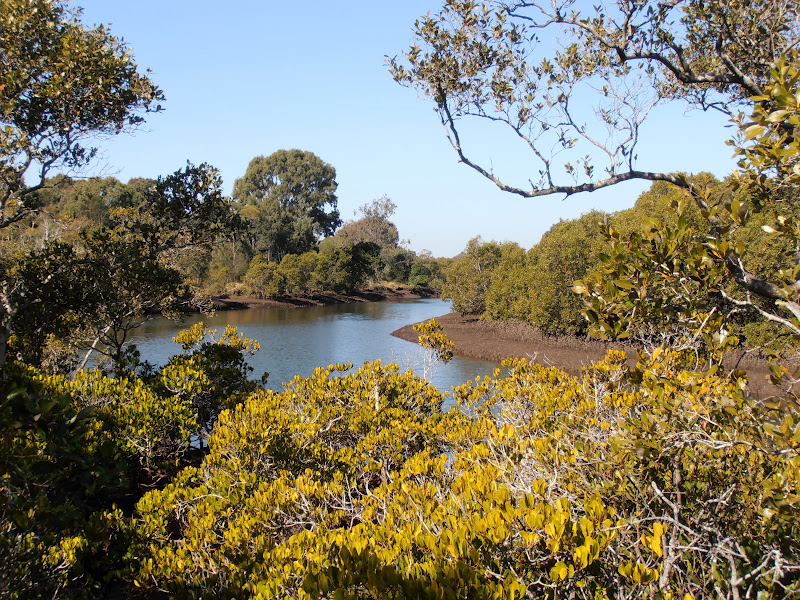
Mangroves
The Boondall Wetlands borders on to all of this and we took advantage of the excellent boardwalk through the mangroves. Here two mangrove species grow along the creek; the grey and the river, one dark green and the other almost yellow. Ibis, herons and a host of other wading birds hang about oblivious to the occasional board walker. It was interesting to note that many migrating birds stop over here for a breather between their flights from New Zealand to Siberia or China. Very discerning travellers!